


This post may contain affiliate links. Please read my disclosure policy.
Asazuke at a Glance
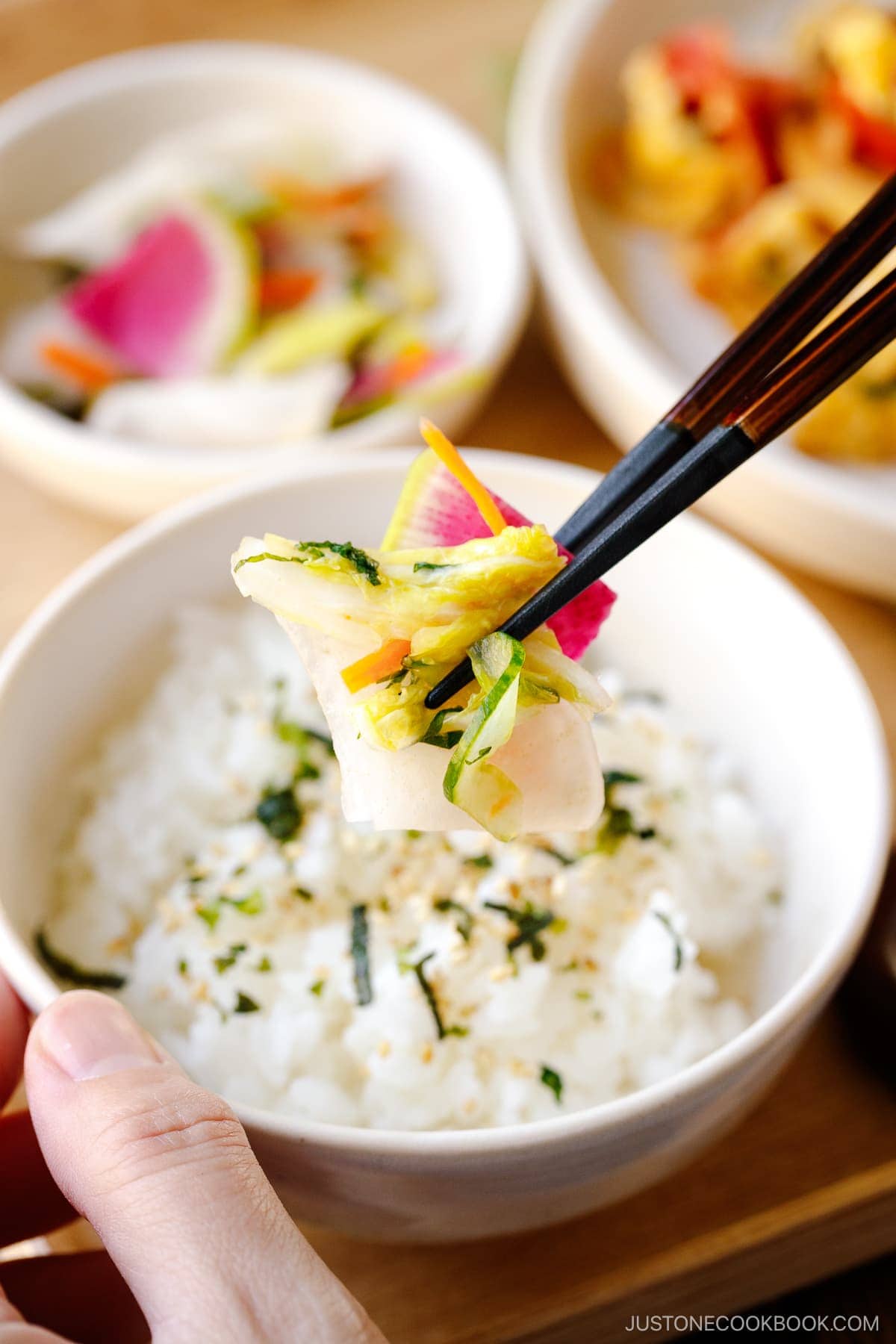
Asazuke (浅漬け) are everyday Japanese pickles that are in the kitchen of most Japanese home cooks. Napa cabbage, daikon radish, cucumber and carrot are cut small, salted or seasoned, and pressed under a weight until they are lightly pickled.
Why You’ll Love It
- Ready in an hour with no lengthy fermentation – Traditional tsukemono ferment for days or months. These pickles are salted, weighted, and on the table in an hour.
- Kombu seaweed adds depth – It makes these taste like authentic Japanese pickles rather than simply salted vegetables.
- Uses up whatever is left in the fridge – Add the odds and ends from your vegetable drawer for a mix that changes with the seasons.
My Recipe Story
Of all the Japanese pickles I’ve put on this site, this is the one I make the most often. I start a batch first when I’m getting a meal together, so by the time everything else is on the table the pickles are ready. I like to call them my everyday pickles because you can really add them to any meal.
If you love Japanese pickles, try my Pickled Daikon, Shiozuke (Salt Pickling), and Pickled Turnip with Yuzu next!

What is Asazuke?
Asazuke (浅漬け)—also known as sokusekizuke (即席漬け) or oshinko (お新香)—refers to Japanese vegetables that are lightly pickled for a very short time, usually 1 to 3 hours.
Unlike traditional tsukemono that require days or months of fermentation, asazuke relies on simple salt and osmotic pressure to draw out water and season the vegetables quickly.
This quick method preserves the vibrant colors, crisp crunch, and natural fresh flavors of the produce, making it an easy, everyday side dish for a traditonal ichiju sansai meal.

Key Ingredients
Almost any vegetable works here. You’ll need handful pantry ingredients such as salt, sugar, kombu, toasted sesame oil, and sesame seeds.
- Kombu (dried kelp) – Not optional. Naturally rich in glutamate, kombu adds the umami that long-fermented pickles develop over time. Since asazuke is ready in just an hour, kombu gives it savory depth right away. For substitute, a pinch of katsuobushi (bonito flakes), dashi powder, or kombucha powder (kelp tea powder) works.
- Salt – Measured by weight; 2–2.5% of whatever the vegetables weigh.
- Something crunchy and something soft – Daikon, watermelon radish, and carrot hold their bite while napa cabbage and cucumber go tender.
- Toasted sesame oil – A little bit of drizzle brings out flavors and appetite.
- Shiso and yuzu zest – Optional, and worth seeking out. Every winter I prepare yuzu zest from a few yuzu and freeze it, and that goes into miso soup, noodle soup, and these all year.
How to Make Asazuke
- Cut everything small. Slice the napa cabbage, then thinly slice the daikon, watermelon radish, and cucumber. Julienne the carrot and the shiso leaves, if using.
- Weigh, then salt. Weigh the vegetables and multiply by 0.02 (for 2% salt) or 0.025 (for 2.5% salt). Add the salt, sugar, and kombu.
- Massage and press. Work the salt in with your hands, weigh the vegetables down, and pickle in the refrigerator for 1–3 hours or up to overnight.
- Drain. Remove the weights, discard the liquid the vegetables released, and transfer them to a clean airtight container.
- Serve. Take out a portion with a clean utensil. I mix in yuzu zest, drizzle sesame oil, sprinkle sesame seeds, and toss gently.


Nami’s Recipe Tips
Here are some of my tips to succeed in making asazuke:
- Balance color and texture – Follow the vegetable list the first time, then swap in what’s in season or needs using up. Aim for something crunchy and something soft in the same bowl.
- Weigh the vegetables, don’t spoon the salt – You never have exactly the same amount of vegetables twice, so a fixed spoonful would be too much in one batch and too little in the next. A digital scale is the one tool this recipe really needs.
- Start tasting at 1 hour – The pickles keep developing, so taste again at 2 and 3 hours to find the point you like best.
- Press under a weight – Weighting the vegetables keeps them under the brine they release and drives the salt in faster. Lighten the weight once the liquid comes out; they’re submerged by then and don’t need forcing down. Anything heavy works — I stack glass bowls on top.

Storage Tips
- To Store: As the vegetables continue to pickle and become saltier, discard any liquid. Keep the pickles in an airtight container and store in the refrigerator for up to 3-4 days.
- To Serve: Use clean utensils to take out the portions you need and promptly put the container back in the refrigerator.
What to Serve with Asazuke
Lightly salted pickles cleanse the palate and go with white rice, the staple of the Japanese table. A small dish of asazuke or tsukemono comes with almost any Japanese meal.
- Rice: Japanese White Rice (made on the stove)
- Soup: Daikon and Fried Tofu Miso Soup
- Main: Teriyaki Salmon
- Sides: Chrysanthemum Greens Salad


FAQ
Can I pickle for a longer time?
Yes, up to overnight. Taste at 1 hour, then again at 2 and 3, and stop where you like it.
Salt is the other control, and it changes the texture more than the time does. At 2–2.5%, which is what this recipe uses, the vegetables give up a lot of water and turn properly pickled. If you drop to 1%, they soften but keep their bite. Pick the number for the texture you want, then use time to fine-tune it.
Can I use other vegetables?
Absolutely! I often make changes based on seasonal availability. Keep in mind that denser vegetables take longer to pickle, and some vegetables release more water than others. Experiment to find the combination that works best for you. Give green cabbage, red radishes, turnips, celery, and cauliflower a try. Or pickle one vegetable on its own, like my Pickled Cucumbers with Ginger recipe.
Can I keep asazuke longer than 3-4 days?
Unfortunately, no. Asazuke pickles don’t last long for two main reasons: 1) they use raw vegetables, which are cut into small pieces and have a large surface area exposed to air, and 2) they have a lower salt concentration (typically 2-3%) than more traditional fermented pickles, making it easier for bacteria to grow.
I’d love to hear how yours turned out! 💛 Please leave a star rating and comment below to share your experience. Your feedback not only supports Just One Cookbook but also helps other home cooks discover recipes they can trust.
Asazuke (Japanese Lightly Pickled Vegetables)

Ingredients
- 4 leaves napa cabbage (11 oz, 300 g; or use green cabbage)
- 2 inches daikon radish (6 oz, 170 g; or use turnips or cauliflower)
- 1 Japanese or Persian cucumber (4.5 oz, 128 g)
- ½ watermelon radish (3.5 oz, 100 g; or use red radish)
- ⅓ carrot (1.6 oz, 45 g)
For the Seasoning
- Diamond Crystal kosher salt (2–2.5% salt; we‘ll calculate the amount of the salt based on the weight of your vegetables)
- ½ tsp sugar
- 1 piece kombu (dried kelp) (1 x 2 inches or 2.5 x 5 cm per piece; see Notes below)
- 5 shiso leaves (perilla/ooba) (optional)
For Serving
- toasted sesame oil (for drizzling)
- toasted white sesame seeds (for sprinkling)
- yuzu zest (optional; lemon zest)
Instructions
Before You Start
- This recipe requires a minimum pickling time of 1 hour (or up to overnight). Gather all the ingredients. Prepare a large bowl. Take note of how much the empty large bowl weighs using a digital kitchen scale so the vegetable weight comes out accurate.

To Prepare the Ingredients
- Cut 4 leaves napa cabbage into 1-inch (2.5-cm) pieces widthwise. Then, cut them into bite-size pieces. Transfer them to the large bowl.Nami's Tip: Follow the vegetable list the first time, then adjust for color, texture, and what's in season. Aim for crunch and softness in the same bowl.

- Peel 1 Japanese or Persian cucumber in a striped pattern. Thinly slice it ⅛ inch (3 mm) thick using a mandoline slicer or sharp knife.

- Peel the skin of 2 inches daikon radish and cut it in half lengthwise. Using a mandoline or sharp knife, thinly slice it ⅛ inch (3 mm) thick.

- Peel ½ watermelon radish and thinly slice it ⅛ inch (3 mm) thick with a mandoline or sharp knife. Slicing is easier while the piece is still large, so halve it rather than quarter it if you can manage.

- Peel ⅓ carrot. Using a julienne peeler or knife, cut the carrot into julienned strips. Cut in half or thirds if the strips are long.

- Cut 5 shiso leaves (perilla/ooba) in half widthwise and roll them up to cut into julienned strips.

To Weigh the Ingredients and Season
- Weigh the vegetables on a digital scale, subtracting the weight of the bowl. Asazuke is typically 2% to 2.5% salt. Multiply the vegetable weight (512 g) by 0.020 (for 2% salt) or 0.025 (for 2.5% salt). Add the calculated amount of Diamond Crystal kosher salt to the vegetables.2% salt: 512 g x 0.020 = 10.24 g (about 3½ tsp)2.5% salt: 512 g x 0.025 = 12.8 g (about 4½ tsp)

- Add ½ tsp sugar to the vegetables. Cut 1 piece kombu (dried kelp) into thin strips with kitchen shears. Add the kombu and julienned shiso leaves.Nami's Tip: If the kombu is too hard, toast it over an open flame to make it tender.

To Massage and Pickle
- Massage the salt into the vegetables with your hands. Then, press the vegetables with some weights. Here, I placed multiple glass bowls on top to press them down. Cover and let them pickle in the fridge for 1–3 hours. Lighten the weight once the liquid comes out.Nami's Tip: Start tasting at 1 hour. Compare again at 2 and 3 hours to find the point you like, since the flavor keeps developing the whole time.

- After pickling, remove the weights. Discard the liquid that the vegetables released into the bowl. Transfer to a clean airtight container.

To Serve
- Take out the desired portion with a clean utensil. Drizzle with a touch of toasted sesame oil, then top with toasted white sesame seeds and yuzu zest. Toss gently and serve immediately.

To Store
- Keep the pickles in an airtight container and store them in the refrigerator for up to 3–4 days. Always use a clean utensil to remove the pickles from the container.

Notes
Nutrition
The nutrition facts shown are generated by an online calculator and are estimates only. Please consult a professional nutritionist for specific dietary needs.
Did you make this recipe?
Tag @justonecookbook on Instagram so we can see your delicious creation!
Editor’s Note: This post was originally published on March 25, 2024, and updated with improved step-by-step instructions on September 22, 2026.